Community Organization

Morning Glory Bee Project

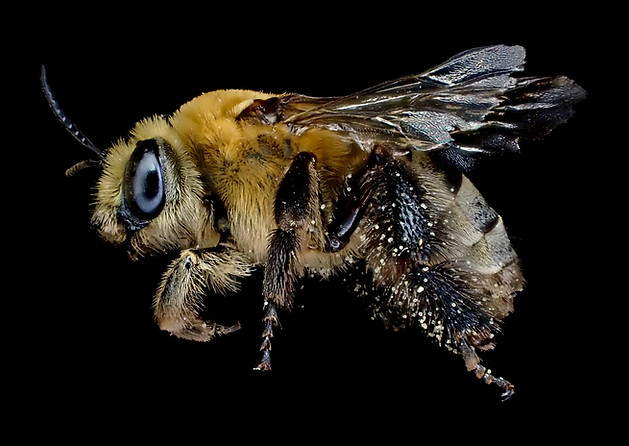
Wild potato vine (Ipomoea pandurata), a native morning glory, grows across the eastern U.S. This perennial vine supports numerous pollinators, including a handful of specialist bees that select the pollen from their flowers to feed their young. The loss of wild potato vine in an area can considerably impact pollinator communities, especially for pollen specialists like the morning glory bee (Xenoglossa [Cemolobus] ipomoeae) who disappear entirely. This bee, in particular, is of conservation concern, which is why we're highlighting the species here.
Why study morning glory bees?
Native bee scientists consider morning glory bees ‘uncommon’ to ‘rare’ due to the few specimens documented over the past several decades. Since 2010, the species has been documented in a portion of its conventionally accepted range (Midwest and Atlantic states) as well as to the southwest in Mississippi (2017; Parys et al. 2024) and to the west in Colorado (2013 & 2014; Carper et al. 2019). Significant gaps are present between these records leading scientists to question whether the species range is indeed “spotty” and disjunct, or that too few surveys have been completed between known occurrences. Additionally, the “timing” of traditional hand-netting surveys tends to miss the period of day in which morning glory bees are most active (i.e., sunrise to noon.) which may also contribute to a lack of records.

Life History
Morning glory bees are oligolectic/monolectic, specializing in collecting pollen of wild potato vine to provision their nests. They seek out this plant, which is why standard bowl trapping is not the best method to survey the species. While this native morning glory has a wide distribution, it has been labeled by farmers as a weed and consequently targeted for removal via herbicides. Additionally, the open habitats (e.g., forest edges; old fields; prairies) in non-agricultural landscapes in which the vine occurs have declined and degraded. These factors may contribute to the potential rarity of morning glory bees. Completing range wide surveys is necessary to arrive at an accurate understanding of the conservation status of the species.
Project Overview
Doug has worked over the past several years to document morning glory bees--and other bees using wild potato vine--in southwest Ohio and other areas in the Midwest. To better understand the conservation status and the actual range of the species, we highly recommend conservation groups completing matinal surveys in states within portions of the historic range that lack contemporary records (2010 and later). According to the Global Biodiversity Information Facility (GBIF), seven states have post-2010 records: Colorado, Illinois, Indiana, Maryland, Ohio, Pennsylvania, and Virginia. Survey efforts prioritize what we consider Tier I states (n = 7)—states within the “core” of the historic range—that will allow us to “bridge the gap” between known occurrences, including Kansas, Missouri, Arkansas, Tennessee, Kentucky, West Virginia, and North Carolina. Other states (Tier II, n = 5) we hope to sample include South Carolina, Georgia, Florida, Alabama, and Louisiana. Tier III states (n = 7) include those comprising the periphery of the species range, including Texas, Oklahoma, Nebraska, Iowa, New York, Michigan, and Wisconsin. Of course, all of this depends on funding and collaboration with partners in each state.
Currently, Doug continues his efforts to monitor known populations in southwest Ohio and identify suitable habitat with potential to support morning glory bees. Those interested in assisting in these efforts and the broader surveys in other aforementioned states, please contact Doug at doug@loveourland.org.


How you can help
If you're interested in supporting the Morning Glory Bee Project, there are multiple ways you can help:
1) Download the mobile app iNaturalist to collect images, videos, and/or audio of various organisms you encounter while outdoors. These apps give individuals the ability to become citizen scientists who collect data that are used by professionals to better understand the statuses of various species, including the morning glory bee. In particular, we're interested in documenting morning glory bees and wild potato vine, though we're also interested in any species observed using wild potato vine.
2) Contact Doug (doug@loveourland.org) to obtain the survey protocol for morning glory bees. With this you'll be able to complete scientifically robust surveys that can inform scientists about the status of morning glory bees across their range.
3) Share our page with friends, family, colleagues, and others in your community. The more people aware of this species, the more data we can collect.